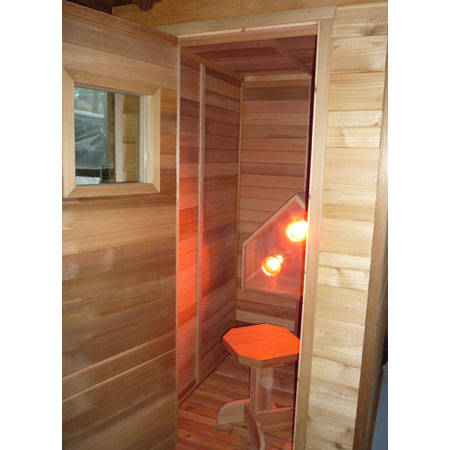
“Near infrared sauna” is used for several different products. Some use broad-spectrum heat lamps inside an enclosure; others combine infrared cabin heaters with light panels. A dedicated red/near-infrared panel is another category. Identify the actual sources and intended use before comparing benefits or prices.
Three formats to distinguish
| Format | Typical buying questions | Important distinction |
|---|---|---|
| Lamp-based enclosure | How do you sit, maintain clearance and orient toward the lamps? | Heat and light come from the actual lamp design, not a name alone. |
| Infrared cabin with added light features | Which sources are included and independently controlled? | Heating coverage and light exposure are separate specifications. |
| Dedicated light panel | What distance, duration and environment are approved? | It is not automatically a sauna or suitable for use inside one. |
What infrared means
Infrared is electromagnetic radiation beyond visible red light. Near, mid and far describe regions of that spectrum; conventions for boundaries can differ. NASA’s infrared overview explains the basic distinction.
The older article attributed a blanket nine-inch tissue penetration claim to NASA and suggested that near-infrared inherently has safe fields while FIR is harmful. Those claims were not a valid basis for choosing a sauna and have been removed. Source power, wavelength, exposure and device design all matter.
Current products and older names
The earlier list included names such as SaunaSpace Luminati and Faraday as well as specific Cedarbrook and Sauna Fix configurations. Do not treat those old names, prices or dimensions as a current catalogue. SaunaSpace now provides FireLight and other current product guides; match the guide to the exact product offered.
If considering an older or used product, ask for its original manual, model identification, electrical rating and parts support. A seller’s newer product page may not describe the used unit.
Lamp enclosure versus wood cabin
In a lamp enclosure, the seat and your orientation toward the source can strongly affect the experience. Consider whether turning, sitting on a stool or maintaining a specified distance is comfortable for you. A wood cabin may use more distributed heaters and a fixed bench, but it also needs more permanent floor space.
Measure the usable seating area and entry. Foldability is useful only if you have room to cool, dry and store the enclosure. Do not pack a damp or hot system away.
Red light claims need their own evidence
A colored lamp, decorative cabin lighting and a purpose-designed light device are not interchangeable. Ask for wavelengths, source specifications, distance and instructions. If a medical outcome is claimed, ask whether the research studied the actual exposure and relevant population.
More wavelengths do not prove a more complete detox. Nor does sweat quantity measure clinical effectiveness. See the comparison archive for the four-way SaunaSpace, Sunlighten, Joovv and Clearlight guide.
Electrical fields and materials
A “near infrared” label does not determine magnetic or electric fields from wiring and components. Ask for model-specific reports, instruments and measurement locations. “Zero” can mean below an instrument’s detection capability rather than the absence of all fields.
Similarly, natural wood or cotton is not a universal guarantee against odor or sensitivity. Check the full material specification and care instructions. A report should identify the tested assembly and conditions.
Installation and ownership checks
- Approved power connection and circuit.
- Required lamp guards, mounting and clearances.
- Seat, entry and source-specific eye precautions.
- Temperature and location limits for every accessory.
- Replacement lamps or components and service support.
- Warranty and opened-product return terms.
Do not reproduce a commercial kit with generic lamps and a privacy tent on the assumption that it is equivalent. Do not add lamps to a cabin without manufacturer approval and appropriate electrical assessment.
FAQs
Does near infrared always mean no heat?
No. The actual source and exposure matter. A light panel and a heat lamp can have very different intended effects.
Is it better than far infrared?
There is no universal winner. Compare the experience, documented design and evidence for the specific claim.
Does it replace sunlight?
A device’s selected wavelengths should not be described as equivalent to all aspects of sunlight exposure.
For cabin choices and ownership costs, use the main guide.